Style your closet, your way



· 4 min read
capsule wardrobe outfit formula wardrobe planning AI styling occasion mapping
I had 30 capsule pieces. I wore 7 of them on rotation. The other 23 sat there — perfectly good clothes, money spent, space taken — because I genuinely could not see how they worked together.
This wasn’t a taste problem. It was a math problem. And there’s a formula for it.
The Capsule Wardrobe Lie
The capsule internet sold me a list. 33 items. Neutral palette. “Versatile basics.” They showed me the flat lay. They didn’t show me the Tuesday morning reality: standing in front of those 33 items, late for a client call, reaching for the same black trousers and white tee I wore Monday. And Wednesday. And Thursday.
The math is brutal. Thirty pieces should yield hundreds of outfits. Combinatorially, 30 items taken 3 at a time (top, bottom, layer) = 4,060 combinations. Even with constraints — color matching, occasion fit, season — you should see 100+ wearable outfits. Most people wear 7.
The gap isn’t your wardrobe. It’s your brain. Human working memory holds 4-7 items max. You cannot mentally cross-reference 30 pieces against 5 occasion types against 3 weather scenarios against your actual calendar for the week. You default to the 3 outfits you already know work.
The Hidden Structure: Occasion × Category × Color
Every outfit that actually gets worn solves three constraints simultaneously:
Occasion constraint — What you’re doing dictates the formality floor. Client presentation ≠ coffee run ≠ dinner date ≠ airport travel. Each has a minimum dress code. Your capsule pieces each have a maximum dress code. The overlap is where outfits live.
Category constraint — You need one top, one bottom, one layer (optional), one shoe. That’s the atomic unit. Missing any category = no outfit. Most capsules have category gaps: 12 tops, 3 bottoms, 0 structured layers. The math breaks before you start.
Color constraint — Not “neutrals go with everything.” That’s lazy advice. Navy doesn’t go with black in certain lights. Olive reads differently next to cream vs. white. The 3-color rule (dominant, secondary, accent) creates visual coherence without monotony. Your capsule needs a defined palette with documented pairings, not a Pinterest board of “earth tones.”
When you map every piece against all three constraints, the invisible outfits appear. That silk camisole you bought for “nice dinners” actually works under the oversized blazer for “creative client pitch” with the dark wash jeans for “casual Friday.” Three constraints satisfied. One new outfit unlocked.
The Sudoku Framework: 3×3×3 = 27 Guaranteed Outfits
This is the framework that changes the math. Build your capsule as a 3×3×3 grid:
3 Categories — Tops, Bottoms, Layers (9 pieces each category = 27 pieces total)
3 Occasion Tiers — Casual (errands, coffee, travel), Smart Casual (creative work, dinner, dates), Elevated (presentations, events, interviews)
3 Color Families — Your core neutral (navy/black/charcoal), your bridge color (cream/olive/camel), your accent (rust/mustard/emerald/blush)
Every piece gets tagged: Category + Occasion Tier + Color Family. The white tee = Top + Casual + Core Neutral. The structured blazer = Layer + Elevated + Core Neutral. The camel trousers = Bottom + Smart Casual + Bridge Color.
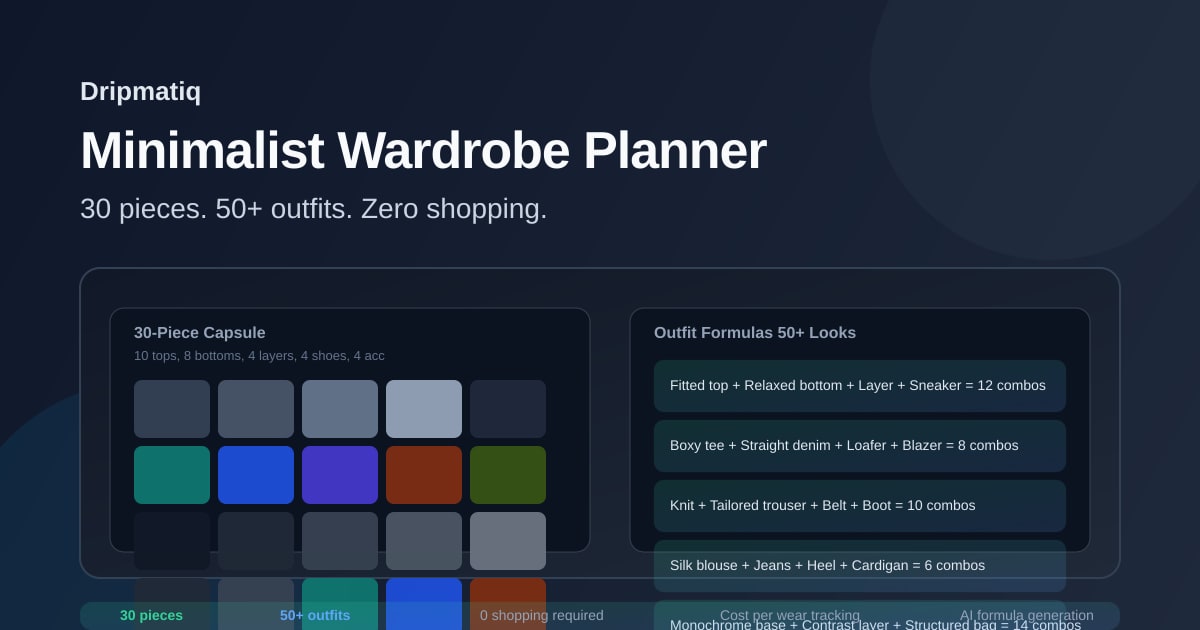
Now the combination engine runs automatically. Filter by occasion tier → see all pieces rated for that tier or below. Filter by color family → see documented pairings. The 3×3×3 structure guarantees 27 base outfits (3 tops × 3 bottoms × 3 layers) before you even add shoes, accessories, or mix occasion tiers.
Real example from a Dripmatiq user: 27 pieces mapped to the grid. She thought she had “nothing to wear.” The engine surfaced 47 outfits for her actual calendar week. She wore 12 unique combinations in 5 days. The pieces didn’t change. The visibility did.
From Static List to Dynamic Engine
A PDF capsule guide is a snapshot. Your life isn’t static. Tuesday’s client call moves to Thursday. Wednesday’s dinner becomes lunch. The weather shifts. Your laundry cycle removes 3 pieces from circulation.
A dynamic combination engine recalculates in real time. Input: your actual pieces (photo or manual entry), your actual calendar (synced or manual), your actual weather (location-based). Output: 5 outfit recommendations for tomorrow, ranked by occasion fit + weather appropriateness + “haven’t worn this combo recently” weighting.
This is what Dripmatiq does. Not “here’s a capsule template.” Not “here’s a static grid.” Your clothes. Your calendar. Your combinations. Calculated fresh every morning.
The user who mapped 27 pieces to the 3×3×3 grid? She didn’t buy a single new item. She just finally saw what she already owned.
Ready to see the outfits hiding in your closet? Dripmatiq maps your actual pieces to your actual life — no shopping required.
Your closet, decoded.
See what you already own in a whole new way.