Style your closet, your way



· 5 min read
decision fatigue wardrobe visibility occasion mapping AI styling
You stand in front of a packed closet. Hangers fight for space. Drawers stick. And your brain serves up one clear thought: I have nothing to wear.
It’s not a volume problem. It’s a visibility problem.
The average American owns 148 clothing items. They wear 18% of them. That means 121 pieces sit idle while you rotate the same 27 items. The panic isn’t scarcity — it’s signal loss. Your depleted brain can’t find the good options buried in the noise.
The Morning Cognitive Glitch
Your brain doesn’t inventory your closet. It samples it.
Every morning, you glance at the front third of the rod, the top drawer, the “recent wears” chair. Your pattern-matching engine checks today’s occasion against that sample. No instant match? Signal: nothing to wear.
Even if the perfect combo sits three hangers back.
This is the availability heuristic — you judge your wardrobe by what’s cognitively available, not what’s physically present. A 2024 Journal of Consumer Research study found people underestimate their outfit options by 67% when viewing a cluttered closet versus an organized one. Same clothes. Different cognitive load. The “empty” feeling vanished when visibility improved.
Decision Fatigue Wears a Disguise
By 9 AM you’ve made 200+ micro-decisions. Coffee. Email priority. Route. Slack status. Your prefrontal cortex is tapped before you open the closet.
Decision fatigue doesn’t feel like tiredness. It feels like dislike. The blazer you loved Tuesday feels “wrong” Wednesday. The jeans that fit perfectly feel “off” because your brain is too depleted to evaluate fit — it just wants the path of least resistance.
The spiral:
- Brain depleted → can’t evaluate options
- Default to “nothing works” narrative
- Anxiety spikes → narrower cognitive tunnel
- Fewer options register → “confirmed: nothing to wear”
- Buy something new → temporary relief → cycle repeats
Breaking this doesn’t require more clothes. It requires reducing the decision surface area so your depleted brain still finds the good options.
Why Visibility Beats Volume
The 18% Reality
That 18% wear rate? It’s not random. It’s the visibility core — items that are:
- Physically accessible (front, eye-level, unfolded)
- Mentally indexed (you know they work for specific occasions)
- Friction-free (clean, ready, no repairs needed)
The other 82% fails one or more. Buried in a bin? Invisible. Dry clean only? Friction. “Maybe someday” fit? Mental index says “risk.”
You don’t need more clothes. You need more of your clothes in the visibility core.
The Three Visibility Killers
1. Physical burial — Items behind other items, in bins, under bed, other closet. If you can’t see it in 3 seconds, it doesn’t exist to your morning brain.
2. Occasion ambiguity — You own a gorgeous rust sweater. But when? Not “fall.” Not “casual.” Which specific Tuesday? Without a mapped occasion, the brain files it as “uncategorized” — aka invisible.
3. Combination blindness — You see pieces. Your brain needs outfits. Skirt + top + shoes + jacket = one decision. Four separate pieces = four decisions. Decision-fatigued brains choose “nothing” over “assemble.”
The Fix: Occasion Mapping Restores Visibility
Map Your Actual Week (Not Your Fantasy Week)
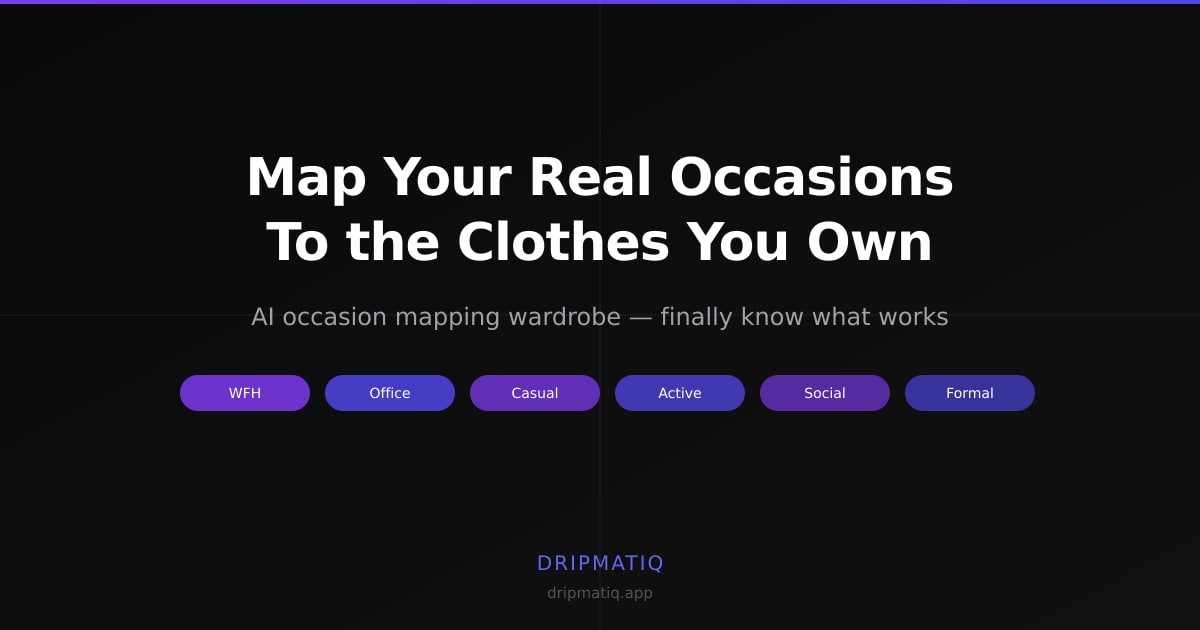
Write 7 real days. Not “work.” WFH Monday, client call Tuesday 2 PM, gym Wednesday 6 AM, errands Saturday 10 AM. Specificity creates occasion slots your brain can match clothes to.
Example real week:
- Mon: WFH, grocery 6 PM
- Tue: Gym 6 AM, office 9-5 (business casual), drinks 7 PM
- Wed: WFH, school pickup 3 PM, casual dinner
- Thu: Office (semi-formal), evening event
- Fri: WFH, date night
- Sat: Park with kids 10 AM, errands 2 PM
- Sun: Meal prep, family dinner 6 PM
That’s 9 distinct occasion slots. Not “work” and “weekend.” Nine.
Audit Every Item Against the Map
For each piece: Which of these 9 slots does this serve?
Rust sweater: Tuesday drinks? Yes. Saturday park? Yes. Monday grocery? Maybe. Thursday office? No. Friday date? Yes.
Result: 4/9 occasion coverage. High visibility. Keep. Promote to front.
Silk camisole: Zero slots. Result: 0/9. Donate. It was never visible anyway.
Structured blazer: Thursday office only. 1/9. But — if Thursday goes remote, 0/9. Flag as “occasion-dependent.” Keep only if Thursday office is guaranteed.
Build Outfit Combos Per Slot (Not Per Piece)
For Tuesday drinks: rust sweater + dark jeans + ankle boots = Outfit A. For Saturday park: rust sweater + leggings + sneakers = Outfit B. For Friday date: rust sweater + midi skirt + heels = Outfit C.
One piece. Three pre-decided outfits. Zero morning decisions.
When you map pieces → occasions → pre-built combos, you replace 47 micro-decisions with 1 recognition: “It’s Tuesday drinks → Outfit A.”
The AI Shortcut: Automate the Visibility Core
Manual mapping works. Once. Then life shifts. Tuesday drinks become Tuesday yoga. Office goes hybrid. The map rots.
AI wardrobe tools solve the maintenance problem by:
- Ingesting your closet — photo upload or retailer sync
- Learning your actual schedule — calendar integration + wear logs
- Calculating real-time occasion coverage — which pieces serve which slots this week
- Surfacing the visibility core — “These 23 items cover 8 of your 9 occasions. Wear these.”
- Flagging gaps — “Zero pieces for Thursday semi-formal. Three items under $150 fix it.”
Dripmatiq does exactly this. Upload your closet. Connect your calendar. The app shows your visibility core in real time — the pieces that actually serve your life this week. No spreadsheet. No seasonal audit. Just the 18% that matters, surfaced automatically.
FAQ
How do I know which occasions I actually have?
Track your calendar for two weeks. Every event, every routine. Gym? Occasion. School pickup? Occasion. “Might grab drinks”? Not an occasion — yet. Only confirmed, recurring slots count. Aspirational occasions create the fantasy wardrobe trap.
What if my week changes constantly?
Map the anchor occasions — the ones that repeat 80% of weeks. WFH days. Gym days. Standing meetings. The variable 20% (dates, events, travel) get a “wildcard” slot. Build 2-3 wildcard outfits from high-coverage pieces. Done.
Can I do this without an app?
Yes. Spreadsheet. Column A: occasion slots. Column B: items that serve it. Column C: pre-built combo. Update monthly. But you won’t. That’s why the app exists — it turns a monthly project into a daily glance.
Stop Buying. Start Seeing.
The “nothing to wear” feeling is a lie your depleted brain tells you. Your closet isn’t empty. Your visibility is.
Map your real occasions. Audit against the map. Build combos per slot. Automate the maintenance.
You’ll stop buying mistakes. Start wearing favorites. And finally know what you own and what works — because you can actually see it.
Ready to surface your visibility core? Dripmatiq maps your actual occasions to the clothes you already own — free to start.
Your closet, decoded.
See what you already own in a whole new way.