Style your closet, your way



· 7 min read
AI fashion stylist closet-first styling no-shopping outfits digital wardrobe AI outfit generator
AI Fashion Stylist No Shopping: Get Styled From Your Own Closet
You want style help. You do not want a sales pitch.
Every “AI fashion stylist” on the market promises personalized recommendations. What they deliver is a carousel of affiliate links dressed up as advice. You upload a photo, answer a quiz, and suddenly you’re being sold a $280 blazer you didn’t know you needed.
A real AI fashion stylist with no shopping agenda works differently. It starts with your closet. It ends with outfits you can wear today. No product links. No checkout buttons. Just your actual clothes, understood well enough to be genuinely useful.
This guide explains how closet-first AI styling works, why it beats shopping-driven recommendations, and how to set it up in one weekend.
The Problem With Most “AI Stylists”
The current generation of AI fashion tools has a conflict of interest baked into their business model.
They Optimize for Conversion, Not Wearability
When an app makes money from purchases, its AI is incentivized to show you things you don’t own. The recommendation engine learns what drives clicks and cart adds — not what actually gets worn.
You see this in the output:
- Suggestions that require three new pieces to complete
- “Complete the look” carousels with affiliate links
- Generic inspiration boards that don’t match your actual wardrobe
- Style quizzes that map you to product categories, not your real preferences
They Don’t Know Your Closet
A human stylist who raids your closet knows things no quiz captures:
- That olive blazer runs warm — you only wear it below 65°F
- Those trousers need a specific heel height or the hem drags
- You bought that silk shirt for a wedding and never wore it again
- Your favorite sneakers go with everything except that one midi skirt
Shopping-driven AI has none of this context. It sees “blazer, olive, size M.” It doesn’t know the lived reality of that piece.
What a No-Shopping AI Fashion Stylist Actually Does
A closet-first AI stylist has one job: generate the best possible outfits from what you already own.
Core Capabilities
Complete closet awareness — Every logged item, every tag, every wear entry feeds the model. It knows what you own, what you wear, and what you ignore.
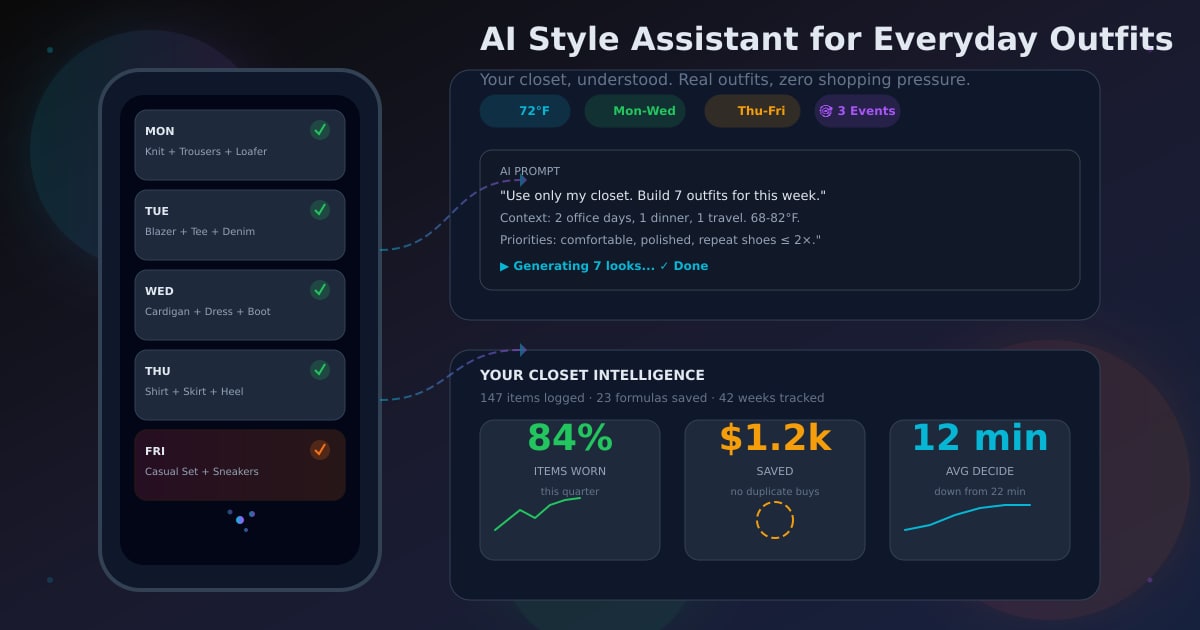
Context-aware generation — You input: “72°F, client meeting then dinner, 30-minute walk between venues, prefer comfortable shoes.” Output: complete looks using only your pieces, with alternatives for each slot.
Wear-history intelligence — The AI learns from what you actually put on your body. It surfaces your high-performing combinations, flags pieces with zero wears in 90 days, and adjusts future suggestions accordingly.
Zero shopping pressure — No “complete the look” upsells. No “you might also like” carousels. If you have a genuine gap, the weekly review surfaces it — but the decision to buy stays entirely yours.
Why Closet-First AI Beats Shopping-Driven Recommendations
1. You Already Own the Solution
The average person wears 20% of their closet 80% of the time. The other 80% isn’t “bad” — it’s invisible. A closet-first AI makes the invisible visible by combining forgotten pieces with current favorites in ways you wouldn’t think to try.
2. Constraints Create Better Style
Infinite options paralyze. Finite wardrobe + smart AI = creative constraint. You get outfits that work because they’re built from real limitations, not despite them.
3. Feedback Loop Compounds
Every week you mark wears, the system gets smarter. Shopping-driven AI has no wear feedback — it only knows what you clicked. Closet-first AI knows what you wore. That difference compounds into genuinely personalized suggestions within weeks.
4. Money Stays in Your Pocket
The average user of a closet-first system reduces impulse purchases by 60-70% in the first 90 days. Not because they’re restricting themselves — because they can see they don’t need more.
One-Weekend Setup: AI Fashion Stylist From Your Closet
You don’t need to catalog everything. You need a critical mass that makes AI suggestions useful immediately.
Step 1: Photograph 30 to 50 Core Items (45 minutes)
Focus on your actual rotation, not your aspirational wardrobe:
- 12 tops you wear weekly
- 10 bottoms in regular rotation
- 6 layers (cardigans, blazers, jackets)
- 8 shoes (include the ones you actually walk in)
- 6 accessories or occasion pieces
Natural light, flat lay or hanger. Phone camera is fine. Skip items you haven’t worn once wore in 2019.
Step 2: Tag for Decisions, Not Perfection (15 minutes)
Every tag should answer: “Would this change whether I wear this today?”
Essential tags:
- Temperature range: cold / mild / warm / hot
- Occasion: work / casual / dinner / travel / active
- Color family: neutral / earth / jewel / pastel / bright
- Comfort: all-day / 4-hours max / sitting only
Skip: brand, purchase date, exact fabric %, original price.
Step 3: Generate Your First AI Outfit Batch (10 minutes)
Use a real week as context. Example prompt:
“Use only my logged closet. Build 10 outfits for the coming week: Mon-Wed work (72-75°F), Thu travel (68°F, lots of walking), Fri dinner (70°F), Sat-Sun casual (75-80°F). Prioritize comfort and shoe re-wear. Give 2 options per day.”
The AI returns complete looks with alternatives. Save the ones that feel right.
Step 4: Plan 7 Days + 2 Backups (10 minutes)
Drag generated outfits to your planner. Check weather. Adjust one layer if needed. Add 2 backup outfits for forecast surprises.
Step 5: Friday 5-Minute Review (5 minutes)
Mark each planned outfit:
- ✅ Wore and loved
- 🔄 Wore with tweak
- ❌ Skipped
Save winners to favorites. Note one genuine gap if it exists. That’s your entire shopping list — one item, justified by data.
Real Results From Closet-First AI Styling
Week 1: Awareness
You see your wardrobe completely for the first time. AI suggests combinations you never tried. Morning decision time drops from 15 minutes to 2.
Week 3: Confidence
Wear data shows your true hero pieces. You stop reaching for the same 3 outfits. AI surfaces forgotten items that match your current plans perfectly.
Week 6: Systematized
You have 20+ saved outfit formulas. Friday review takes 3 minutes. Impulse shopping urges drop because you can instantly check: “Can I build 3 outfits with this?” — usually the answer is already in your closet.
Week 12: Compounded Value
Cost-per-wear across wardrobe increases 40%+. You buy less, wear more, and get dressed faster. The AI stylist has become infrastructure, not a tool you “try.”
Common Mistakes That Break the System
Mistake 1: Logging Fantasy, Not Reality
If you upload the wardrobe you wish you had, AI generates outfits for a person who doesn’t exist. Log what you actually wear.
Mistake 2: Skipping Shoes and Layers
Outfits live or die at the edges. No shoes = incomplete looks. No layers = no weather adaptation. Log them first.
Mistake 3: Treating AI as Oracle, Not Assistant
AI generates options. You decide. If a suggestion feels off, adjust it and save the correction. The system learns from your edits.
Mistake 4: No Weekly Review
Without wear feedback, the AI optimizes for your aspirations, not your reality. The 5-minute Friday habit is what makes the system yours.
Mistake 5: Expecting Perfection on Day One
Day one gives you 60% hit rate. Week two hits 80%. Week four hits 90%+. The system improves every time you use it.
Who Gets the Most Value
This approach pays off fastest if you:
- Feel rushed every weekday morning
- Have a full closet but low outfit confidence
- Switch between work, casual, and social contexts
- Want to reduce fashion waste without giving up style
- Prefer repeating favorites intelligently over chasing trends
- Have tried “AI styling” apps and felt sold to, not helped
If that’s you, a no-shopping AI fashion stylist isn’t a luxury. It’s the highest-leverage style tool you can adopt.
What to Look for in a No-Shopping AI Stylist
When evaluating tools, ask:
- Can I generate outfits without any product links appearing?
- Does the AI use my wear history to improve suggestions?
- Can I filter by temperature, occasion, and comfort simultaneously?
- Is weekly planning built in, or do I need a separate calendar?
- Can I export my data if I leave?
- Does the company make money from my purchases or my subscription?
If the answer to #6 is “purchases,” the conflict of interest remains — no matter how good the AI claims to be.
The Dripmatiq Approach
Dripmatiq was built specifically for this workflow:
- Closet-first architecture — Every feature starts with your logged items
- No affiliate links, ever — Revenue from subscriptions only
- Wear-tracking feedback loop — Friday review feeds next week’s AI
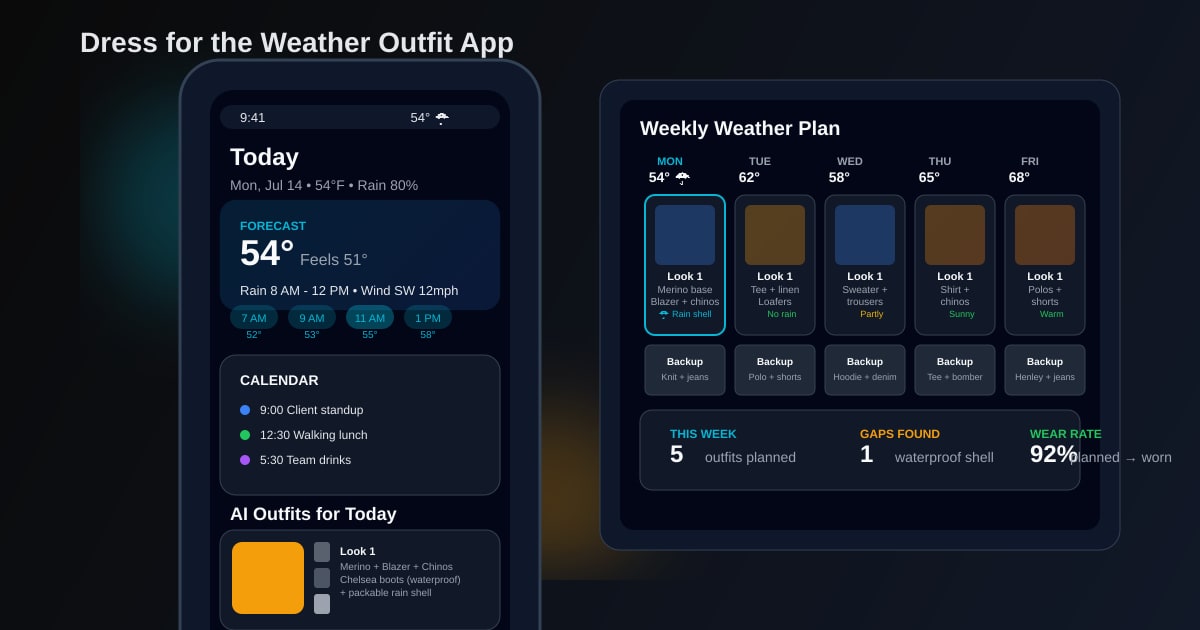
- Weather-aware planner — Forecast sits next to every day slot
- Formula library — Save proven structures, swap pieces infinitely
- Data ownership — Full export, no lock-in
The goal isn’t to be your stylist forever. The goal is to make you self-sufficient — so you eventually don’t need an AI stylist at all.
Final Takeaway
Style isn’t about having more options. It’s about seeing the options you already have.
An AI fashion stylist with no shopping agenda flips the industry model. Instead of using AI to sell you clothes, it uses AI to unlock the clothes you bought and forgot.
You already own a great wardrobe. You just need a system that can show it to you when it matters — 7:40 AM, raining, meeting in 20 minutes.
Start with 30 pieces. One weekend. One week of planned outfits.
The best AI fashion stylist doesn’t send you to checkout. It sends you out the door dressed, confident, and on time.
Want to try closet-first AI styling? Dripmatiq helps you organize your wardrobe, generate daily outfits from your own clothes, and plan your week without a single shopping link.
Your closet, decoded.
See what you already own in a whole new way.