Style your closet, your way



· 6 min read
closet organization AI wardrobe app outfit planning digital closet style productivity
Closet Organization App With AI: Organize Clothes Faster and Build Better Outfits
If your closet is packed but mornings still feel chaotic, you are not the problem.
Most people do not need more clothes. They need better access to the clothes they already have.
That is exactly what a closet organization app with AI can solve.
Instead of staring at hangers and trying to remember what works together, you build a digital version of your wardrobe, add practical tags, and let AI generate outfit options from your real closet. The result is less decision fatigue, fewer duplicate purchases, and a faster way to get dressed every day.
This guide gives you a realistic setup you can finish in one weekend, plus a weekly system that keeps your closet useful long after the initial upload.
Why traditional closet organizing is not enough
Physical organization helps, but only to a point.
You can color-code everything, fold every drawer, and still wear the same few outfits each week. Why? Because the bottleneck is mental retrieval, not storage.
On a rushed morning, your brain reaches for default combinations. You forget half your closet exists. Then you feel bored, assume your style is stale, and start shopping.
A closet organization app with AI fixes that retrieval problem by making your wardrobe searchable and actionable. You can filter by occasion, weather, color, comfort, and then generate full outfit combinations without starting from zero.
Think of it like this:
- Physical organization makes your closet look cleaner
- AI closet organization makes your closet work smarter
What a closet organization app with AI should do well
Not every app that says “AI styling” actually helps in daily life. A useful one should handle five jobs well.
1) Fast wardrobe cataloging
You should be able to add items quickly through simple photos. If setup takes forever, most people quit before getting value.
2) Practical tagging
Tags should help real decisions, not create admin work. At minimum, you want:
- Category (tee, blazer, denim, sneaker)
- Color family
- Warmth or season
- Occasion (casual, work, event)
- Fit or silhouette
3) Closet-based outfit generation
The AI should generate ideas from your own clothes first, not from shopping links or generic inspiration boards.
4) Weekly planning view
You need to map outfits to real days and weather. Planning once saves time all week.
5) Wear history and insights
Without wear tracking, there is no feedback loop. You need to see what you actually wear and what stays ignored so you can improve decisions.
The one-weekend setup that makes AI outfit suggestions useful
You do not need to photograph every sock and scarf. Start with your core rotation.
Step 1: Add your top 30 to 50 items
Pull your most-worn pieces first:
- Everyday tops
- Core bottoms
- Reliable layers
- Main shoes
- A few occasion pieces
Natural light is enough. Flat lay or hanger photos both work.
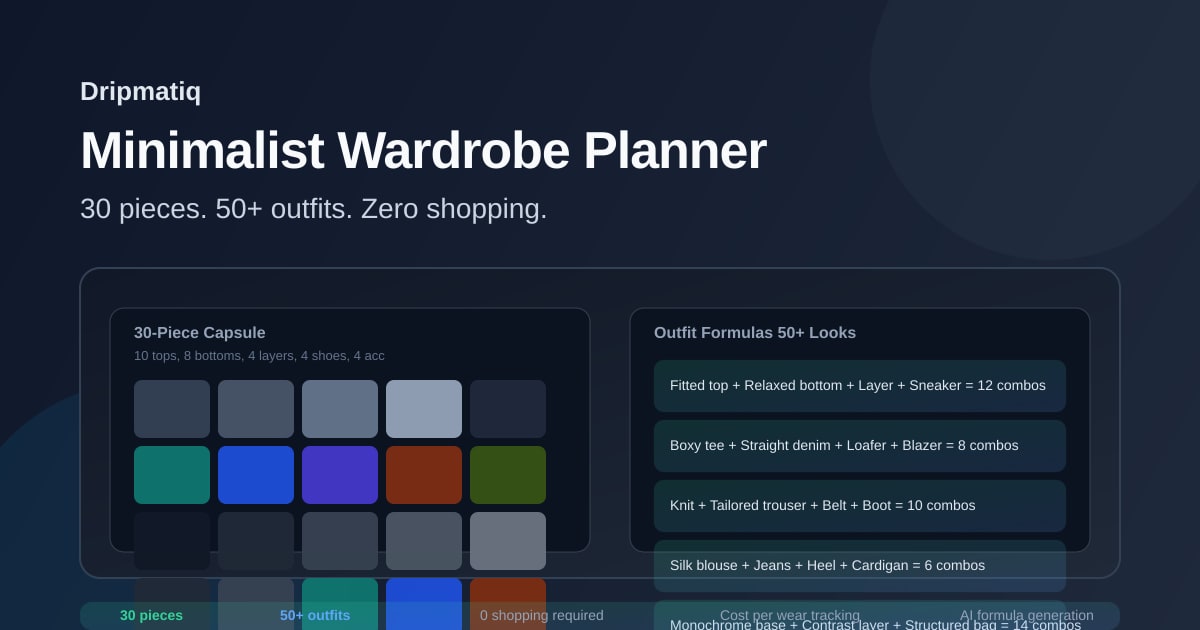
Starting with 30 to 50 items gives enough variety for strong outfit generation without overwhelming setup.
Step 2: Add “decision tags,” not perfection tags
Tag only what changes your daily choice:
- Temperature range
- Dress code
- Comfort level
- Color compatibility
Do not over-tag. The goal is speed and usefulness.
Step 3: Generate your first 10 AI outfits
Use real context in your prompt, for example:
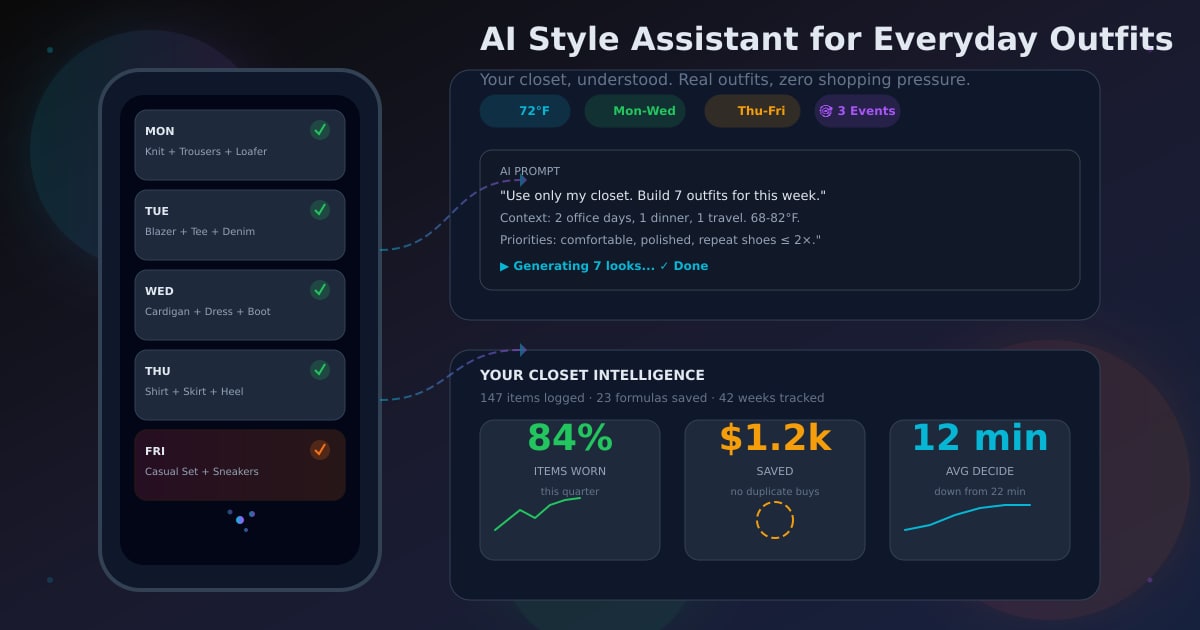
“Use only my closet items. Build 10 outfits for warm weather with two office looks, two casual looks, one dinner look, and one travel look. Prioritize comfort and rewear shoes.”
Context makes AI suggestions dramatically better.
Step 4: Save one week of looks
Plan seven outfits for the week based on your calendar and forecast. Add two backups for weather changes.
This single habit removes most morning stress.
Step 5: Run a five-minute weekly review
At the end of the week, mark outfits as:
- Wore and loved
- Wore with changes
- Did not wear
That data improves future suggestions and shows what your closet actually supports.
How AI closet organization helps you buy less
Most impulse shopping starts with uncertainty, not real need.
You buy because you:
- Forgot you owned similar pieces
- Could not picture new combinations
- Wanted a quick style reset
A closet organization app with AI interrupts that loop by making your current wardrobe visible and combinable.
Before buying a new piece, run this quick check in your app:
- Do I already own a close equivalent?
- Can I style this new piece into three outfits with my existing clothes?
- Does this replace a gap, or duplicate what I already have?
If you cannot build three strong combinations, skip the purchase.
Over time, this simple filter prevents clutter and improves wardrobe quality.
Real benefits you can expect in the first 30 days
When people stick with a good AI closet workflow, they usually notice the same wins fast.
You get dressed faster
Pre-planned outfits and searchable inventory reduce morning decision time.
You repeat outfits more intelligently
Instead of random repeats, you reuse high-performing combinations with small swaps.
You discover forgotten pieces
AI surfaces underused items that still work with your current style.
You reduce duplicate shopping
Seeing your full wardrobe clearly makes “I need this” moments more accurate.
You build a more consistent personal style
You start seeing patterns in color, fit, and silhouette that actually suit your life.
Common mistakes that make closet apps fail
Even strong tools can fail if the setup is wrong.
Mistake 1: Logging only statement items
Your basics carry most outfits. If they are missing, suggestions feel unrealistic.
Mistake 2: Skipping shoes and layers
People often log tops and bottoms only. But shoes and outerwear usually decide whether an outfit works.
Mistake 3: No context in AI prompts
“Give me outfit ideas” is too vague. Include weather, occasion, comfort, and style intent.
Mistake 4: No weekly maintenance
Without review, your closet data gets stale and recommendations degrade.
Mistake 5: Treating the app as a photo archive
A closet app is not a gallery. It is a daily decision tool.
A weekly workflow you can sustain (15 minutes total)
You do not need a complex system. Keep it lightweight.
Sunday (8 minutes)
- Check weather and calendar
- Generate 7 outfits
- Save 2 backups
Midweek (2 minutes)
- Swap one look if weather changes
Friday (5 minutes)
- Mark what you wore
- Save top outfits to favorites
- Note one gap worth fixing
This is enough to keep your wardrobe system improving every week.
Who gets the most value from a closet organization app with AI
This approach is high-value if you:
- Feel rushed every morning
- Have a full closet but low outfit confidence
- Want to shop less and wear more
- Need outfits for multiple contexts (work, casual, social)
- Are building a capsule wardrobe but want flexibility
If that sounds familiar, this is not a “nice-to-have” productivity hack. It is a practical style system.
What to look for in the best closet organization app with AI
When evaluating apps, ask these questions:
- Can I add items quickly without friction?
- Does AI build outfits from my own closet?
- Can I filter by weather, occasion, and comfort?
- Is weekly planning built in?
- Can I track wears and identify underused pieces?
If an app misses those, it may look good but fail in everyday use.
Final takeaway
If your wardrobe feels overwhelming, do not start with another shopping trip.
Start with structure.
A closet organization app with AI helps you see your closet clearly, generate useful outfit options fast, and build a repeatable routine that saves time, money, and mental energy.
You already own more outfit potential than you think.
You just need a system that can surface it when it matters.
Want to try this in real life? Dripmatiq helps you organize your closet, generate AI outfits from your own clothes, and plan your week with less stress and less shopping.
Your closet, decoded.
See what you already own in a whole new way.