Style your closet, your way



· 5 min read
minimalist wardrobe wardrobe planner capsule wardrobe AI styling outfit planning digital closet
Minimalist Wardrobe Planner App: Plan More Outfits With Less Stuff
You do not need more clothes. You need a system that makes the clothes you already own visible, combinable, and deployable on demand.
A minimalist wardrobe planner app does not sell you things. It helps you stop buying things by proving — mathematically — that your current closet already contains next month’s outfits.
Why most wardrobe apps fail minimalists
Most fashion apps are shopping engines disguised as organizers. They show you “completing the look” carousels. They nudge you toward “wardrobe gaps” that conveniently match affiliate links. They treat your closet as a funnel, not a toolkit.
A true minimalist wardrobe planner flips the incentive:
| Typical App | Minimalist Planner |
|---|---|
| Suggests purchases | Suggests combinations |
| Highlights “missing” items | Highlights unused items |
| Measures wardrobe by size | Measures wardrobe by utilization |
| Optimizes for acquisition | Optimizes for cost-per-wear |
If the app makes you want to shop, it is not a planner. It is a catalog.
The math: 30 pieces → 50+ outfits
A minimalist wardrobe is not about deprivation. It is about interchangeability.
When every top works with every bottom, and every shoe works with every bottom, the combinatorics explode:
- 10 tops × 8 bottoms = 80 base combinations
- Add 4 layers that each work over 80% of bases → ~256 layered looks
- 4 shoes that cross casual and smart-casual → every look gets 2–3 footwear options
You do not wear all 256. But you now have curated choice instead of default repetition.
The planner’s job is to surface the 50–70 combinations that actually fit your life: your climate, your calendar, your comfort thresholds.
What a minimalist wardrobe planner must do
1. Enforce a hard cap
You set the limit (30, 33, 37). The app refuses new items until something leaves. This constraint is the feature — it forces curation, not accumulation.
2. Tag for combination logic, not just aesthetics
Tags that drive outfit generation:
- Category (top, bottom, layer, shoe, accessory)
- Color family (neutral, navy, olive, rust, etc.)
- Formality (casual, smart-casual, work, evening)
- Temperature range (hot, mild, cool, cold)
- Silhouette (fitted, relaxed, oversized, tailored)
Aesthetic tags (“boho,” “minimalist,” “preppy”) are noise. Structural tags are signal.
3. Generate formulas, not just outfits
An outfit is a static snapshot. A formula is a reusable pattern:
Fitted neutral top + relaxed neutral bottom + structured layer + clean sneaker = 12 distinct looks across your calendar
The planner should let you save, name, and deploy formulas. One formula beats fifty saved outfits.
4. Plan by calendar + weather, not mood
Mood is unreliable. Calendar and weather are not.
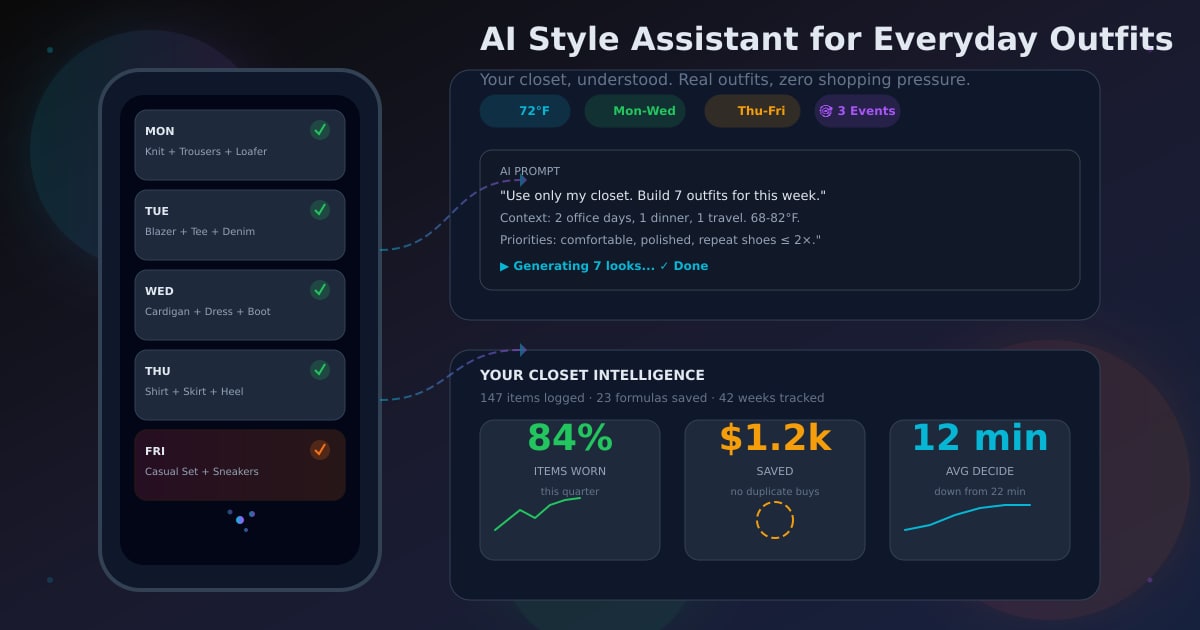
Input: “Tuesday, client dinner, 62°F, rain” Output: 3 complete looks from your 30 pieces, ranked by formality match and weather fit.
5. Track wear data to prove utilization
Every piece gets a wear count. Every outfit gets a rating. After 30 days you know:
- Your 5 hero pieces (worn 8+ times)
- Your 3 ghosts (worn 0 times — candidates for removal)
- Your cost-per-wear on every item
This data is what stops the next impulse purchase. You see the waste.
The minimalist planner workflow (15 min/week)
Sunday: Generate (8 minutes)
- Pull weekly weather + calendar
- App generates 7 base outfits + 2 backups
- Swap one item per look if needed
- Save to weekly view
Daily: Execute (1 minute)
Open app. Wear saved look. Rate comfort/confidence (1–5). Done.
Friday: Review (6 minutes)
- Mark worn items
- Flag discomfort or fit issues
- Note missing combos (“needed a darker shoe for Tuesday”)
- App updates utilization stats
That is it. No daily decision fatigue. No weekend “I have nothing to wear” panic.
Common mistakes that break minimalist planning
Mistake 1: Counting items, not interfaces
A 30-piece closet where nothing matches is worse than a 60-piece closet with high interchangeability. The planner should warn you when a new item has <3 confirmed pairings.
Mistake 2: Forgetting shoes and layers
People log 20 tops and bottoms, 2 shoes, 1 jacket. Shoes and layers are the multipliers. Prioritize them in your 30 slots.
Mistake 3: No “wildcard” slots
Reserve 2–3 slots for non-interchangeable joy pieces: the sequin skirt, the vintage leather, the birthday dress. They don’t need to mix. They just need a home so they don’t derail the system.
Mistake 4: Treating the planner as a photo album
If you are not generating outfits from tags and tracking wears, you are archiving, not planning. An archive does not reduce decision fatigue.
How AI changes the minimalist planner game
Traditional minimalist planning is manual: you build formulas yourself. AI adds leverage in three ways:
1. Auto-tagging from photos
Upload a flat lay. AI returns category, color family, formality, temperature range, silhouette. 30 items tagged in 5 minutes instead of 45.
2. Combination discovery you would miss
Human pattern-matching caps at ~7 simultaneous variables. AI evaluates every tagged attribute across your 30 pieces and surfaces non-obvious pairings — the olive trousers that actually work with the rust sweater because the undertones align.
3. Scenario simulation
“Generate 5 outfits for a 3-day work trip with one carry-on, 55–75°F, two client dinners, one travel day.” The planner solves the packing list and the daily looks in one pass.
Dripmatiq’s minimalist planner approach
Dripmatiq is built on the premise that your best wardrobe is already in your closet.
- Hard cap enforcement (you choose the number)
- Structural tagging schema (the 5 tags that drive combinations)
- Formula builder (save patterns, not outfits)
- Calendar + weather planning
- Wear analytics (cost-per-wear, utilization %, ghost detection)
- AI auto-tagging and combination discovery
- No shopping prompts. No affiliate links. No “complete the look.”
The goal is not a smaller closet. The goal is a closet where every piece earns its space.
Final takeaway
A minimalist wardrobe planner app is not about owning less. It is about using more of what you own.
When you can see 50 real outfits inside 30 pieces, the urge to shop dissolves — not from discipline, but from evidence. You know you are covered.
Stop organizing for storage. Start planning for wear.
Ready to build your 30-piece, 50-outfit system? Dripmatiq helps you cap, tag, formula-plan, and track — all from the clothes you already own.
Your closet, decoded.
See what you already own in a whole new way.