Style your closet, your way



· 6 min read
digital wardrobe outfit planning closet organization AI styling wardrobe tracker
Digital Wardrobe Tracker: Build Better Outfits Without Buying More Clothes
You open your closet. It is full. But it still feels like you have “nothing to wear.”
That disconnect is exactly why interest in the digital wardrobe tracker is exploding. Not because people need more clothing. Because they need better visibility, better planning, and less daily decision fatigue.
A digital wardrobe tracker gives you one home for your real closet: photos, categories, outfit combinations, and wear history. Done right, it turns style from a daily scramble into a repeatable system.
This guide walks you through how to set one up, what features actually matter, and how to use it to get dressed faster while buying less.
Why traditional closet organization breaks down
Most people try to organize their wardrobe physically: color-coded hangers, folded stacks, seasonal bins. That helps, but only up to a point.
The problem is not storage. The problem is retrieval.
On busy mornings, your brain defaults to familiar combinations. You forget half your closet exists. You repeat the same 8 looks, then assume you need to shop.
A digital wardrobe tracker solves this by making your closet searchable:
- Filter by weather and occasion
- Sort by color and silhouette
- See unworn or underworn pieces fast
- Build outfits in advance instead of improvising under time pressure
Physical organization helps your closet look clean. Digital organization helps your closet perform.
What a digital wardrobe tracker should include
Not all wardrobe apps are equal. Some are just inspiration feeds. Some push shopping too hard. Some look great but fail in daily use.
A useful tracker should do five core jobs well.
1) Closet catalog
You need a clean visual inventory of what you own: tops, bottoms, layers, shoes, accessories. If logging feels painful, you will quit.
2) Smart tagging
Basic tags should include:
- Category (tee, trouser, loafer)
- Color family
- Season or temperature range
- Formality (casual, smart casual, work, evening)
- Fit/silhouette (fitted, relaxed, oversized)
Tags are what make outfit recommendations useful instead of random.
3) Outfit builder
You should be able to drag pieces into complete looks, save them, and duplicate them with small swaps (different shoe, different layer, different bag).
4) Wear tracking
If you cannot track what you wore, you cannot improve decisions. Wear data reveals:
- Your real “hero” pieces
- Expensive items with low usage
- Gaps that actually matter
- Duplicates you should stop buying
5) Planning view
A week planner linked to weather and calendar beats morning panic. The more friction your mornings have, the more valuable this becomes.
How to set up your digital wardrobe tracker in one weekend
You do not need to photograph every sock before this works. Start with your core rotation.
Step 1: Log 30 to 50 core items
Pull the items you wear most:
- 12 tops
- 10 bottoms
- 6 outer layers
- 8 shoes
- 6 accessories or event-specific pieces
Take simple photos in natural light. Flat lays are fine. Hanger shots are fine. Perfection is not required.
Why 30 to 50? It gives enough variety for meaningful outfit generation while keeping setup realistic.
Step 2: Tag for decision-making, not perfection
Tag each item with just the fields that influence what you wear:
- Warmth level
- Occasion fit
- Comfort level
- Shoe compatibility
Do not over-tag. If your system becomes too detailed, you will abandon it.
Step 3: Build 10 outfit formulas
Formulas reduce cognitive load. You are not choosing from infinite combinations every morning. You are selecting from proven structures.
Examples:
- Fitted knit + wide-leg trouser + low-profile sneaker
- Button-down + straight denim + loafer + light blazer
- Tank + midi skirt + sandal + cropped jacket
- Monochrome base + textured outer layer + structured bag
Formulas give consistency without making your style feel repetitive.
Step 4: Pre-plan one week
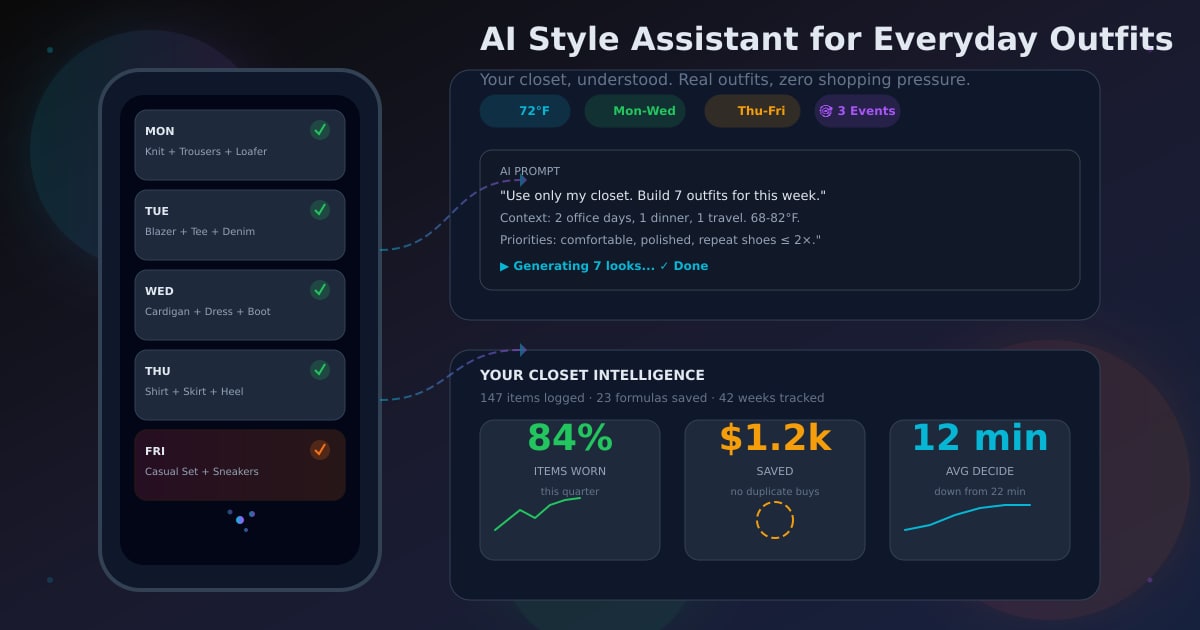
Use your tracker to create 7 outfits matched to weather + calendar:
- Office days
- Errand day
- Dinner/event
- Travel or long walking day
Then add 2 backup outfits for weather shifts or laundry surprises.
Step 5: Run weekly review loop
Every Friday, review what happened:
- Wore and loved
- Wore but adjusted
- Planned but skipped
This tiny loop makes the system smarter each week.
How a digital wardrobe tracker reduces over-shopping
Most unnecessary purchases come from uncertainty, not need.
You buy because:
- You forgot you owned similar item
- You could not picture how to style what you have
- You felt “stuck” and wanted novelty fast
A digital wardrobe tracker interrupts that cycle.
Before buying, check:
- Do I already own a functional equivalent?
- Can I style this new piece into 3 outfits using current closet?
- What item in my wardrobe would this replace, not just duplicate?
If you cannot build three outfits from your existing inventory, it is usually a pass.
Over time, this saves money and makes your closet more cohesive.
AI + digital wardrobe tracker: where the real leverage is
AI is most useful when it works from your actual closet, not generic catalog photos.
With a strong inventory and tags, AI can help you:
- Generate outfits from your own clothes for specific occasions
- Re-style one anchor piece three ways
- Suggest weather-appropriate swaps instantly
- Surface forgotten items that match your current plan
This is where Dripmatiq is strong: it combines closet tracking with AI outfit generation focused on what you already own.
That matters. Generic “style inspo” creates desire. Closet-aware AI creates usable outfits.
Common mistakes that make wardrobe trackers fail
Mistake 1: Logging only statement pieces
If your basics are missing, recommendations break. Plain tees, neutral trousers, and everyday shoes carry most outfits.
Mistake 2: Skipping shoes and layers
People often log tops and bottoms, then wonder why suggestions feel incomplete. Shoes and outer layers usually determine whether an outfit actually works.
Mistake 3: No weekly review
Without feedback, your tracker becomes static. You need wear data to improve planning and spending decisions.
Mistake 4: Expecting perfect results on day one
Week one is setup. Week two gets smoother. Week three delivers real speed.
Mistake 5: Using tracker as archive, not decision tool
This is key. A digital wardrobe tracker is not a museum. It is an operating system for daily style.
A practical weekly workflow (15 minutes total)
If you keep workflow simple, you keep it alive.
Sunday (8 minutes)
- Check weekly weather
- Check calendar constraints
- Generate and save 7 outfits
- Add 2 backups
Midweek (2 minutes)
- Swap one outfit if forecast changes
Friday (5 minutes)
- Mark worn looks
- Note friction points
- Save best combinations to favorites
That is it. No heavy admin.
Who benefits most from a digital wardrobe tracker
This system is especially useful if you:
- Feel rushed in mornings
- Buy clothes but still feel bored by outfits
- Want to reduce fashion waste
- Prefer repeating favorites intelligently
- Need workwear and weekend looks from one closet
- Are building a capsule wardrobe but want flexibility
If any of these sound familiar, a digital wardrobe tracker is not a nice-to-have. It is a high-leverage personal system.
Choosing between “free” and “worth paying for” tools
A free tracker is enough if you only need a visual catalog.
But if your goal is faster daily decisions and fewer bad purchases, pay attention to features that save time:
- Fast upload flow
- Reliable tagging
- Outfit planner
- Wear analytics
- AI suggestions from your own closet
A tool that saves even 10 minutes per day and prevents one duplicate purchase per month often pays for itself quickly.
Final takeaway
If your closet is full but dressing still feels hard, do not start with shopping.
Start with visibility.
A digital wardrobe tracker helps you see what you own, combine it with intention, and plan for real life. Add AI on top, and you move from “I have no idea what to wear” to “I already have three good options.”
That shift saves time, money, and mental energy every single week.
If you want to test this workflow, start small: log your core 30 pieces, build 10 outfit formulas, and run one week of tracked planning. You will feel the difference fast.
Want to put this into action now? Dripmatiq helps you build a digital wardrobe tracker, generate outfit ideas from your own clothes, and plan your week without buying more.
Your closet, decoded.
See what you already own in a whole new way.