Style your closet, your way



· 5 min read
dress codes styling tips event outfits AI styling what to wear outfit confidence
You got the invite. “Cocktail attire.” Two words that somehow explain nothing.
You stare at your closet. You open Google. You text three friends. You get four different answers. You consider canceling. This cycle plays out millions of times a week — and if you’ve ever stood in front of your wardrobe twenty minutes before an event wondering if you’re about to be the most overdressed or underdressed person in the room, you already know the feeling.
On Reddit’s r/OUTFITS, posts asking “is this appropriate for [event]?” routinely pull thousands of upvotes. Interview outfits. Wedding guest anxiety. Dinner date uncertainty. The questions aren’t really about clothes. They’re about not wanting to get it wrong in a room full of people who seem to already know the rules.
Here’s the thing: dress codes aren’t rules. They’re ranges. And once you understand the range, you can stop guessing and start choosing.
Why Dress Codes Feel So Confusing
Dress codes were invented for clarity. Ironically, they now cause more confusion than they solve. “Smart casual” means one thing at a tech company happy hour and something completely different at a country club brunch. “Business casual” has been debated so aggressively online that it might be the most contested phrase in fashion.
The problem isn’t your wardrobe. It’s that dress codes describe a vibe, not a formula. They assume shared cultural context that doesn’t exist anymore. A “cocktail” event in Miami looks nothing like one in Minneapolis.
So stop trying to decode the label. Decode the situation instead.
The Three Questions That Replace Any Dress Code
Before you touch a hanger, answer these:
1. What’s the venue? A rooftop bar, a corporate boardroom, and a backyard cookout each have a built-in formality ceiling. The venue tells you more than the invite does.
2. Who’s hosting? Your friend who wears vintage band tees to everything has a different “dressy” than your boss who irons their jeans. Match the host’s energy, not a dictionary definition.
3. What’s the worst-case scenario? Being slightly overdressed reads as “I cared.” Being underdressed reads as “I didn’t.” When in doubt, dress one notch above what you think the minimum is. A blazer you can take off is always safer than a hoodie you can’t dress up.
These three questions collapse “cocktail attire” from an existential crisis into a solvable problem.
The Actual Dress Code Tiers (Simplified)
Here’s the spectrum most events fall on, stripped of the jargon:
Casual — You’d wear it to grab coffee with a friend. Clean, intentional, but relaxed. Think well-fitted jeans, a thoughtful top, clean sneakers or loafers.
Smart casual — Casual with one upgrade. Swap the sneakers for leather shoes. Add a third piece like a structured jacket or scarf to signal you thought about it.
Business casual — Smart casual minus the jeans. Tailored trousers or a midi skirt, a blouse or button-down, closed-toe shoes. No tie required. No suit required. The goal is “I could walk into a meeting and no one would blink.”
Cocktail — The one that causes the most panic. It means dressy, not formal. A well-fitted dress or a sharp separates combo. Statement earrings or a watch. The vibe is “I’m going somewhere good tonight.” Not prom. Not the Oscars.
Black tie — You actually need the suit or the gown. This is the one dress code that means what it says. If you don’t own formalwear, this is a rental situation — and that’s completely fine.
Most of your life happens between casual and cocktail. Master that range and you’re covered for 95% of invites.
How to Stop Second-Guessing Yourself
The real problem behind dress code anxiety isn’t knowledge — it’s confidence. You probably own something appropriate. You just don’t trust your own judgment.
Here’s a framework that helps:
Start with your anchor piece. This is the one item you feel best in. A dress that always gets compliments. Trousers that fit perfectly. A top you reach for when you want to feel like yourself. Build the outfit around that piece, not around the dress code.
Test the “photo test.” Imagine someone takes a candid photo of you at this event and posts it. Would you feel good about what you’re wearing? If yes, you’re done. If the thought makes you wince, adjust.
Ask one person who’s going. Not three. Not a group chat. One person whose taste you trust. The goal isn’t consensus — it’s a sanity check.
When you read about people who restyle one piece across multiple events, the underlying skill is the same: understanding context and trusting your instinct. The outfit isn’t the hard part. The decision is.
What the Reddit Threads Actually Reveal
Scroll through enough “is this appropriate?” posts and a pattern emerges. The outfits people post are almost always fine. The top comments usually say some version of “yes, you look great, go have fun.”
The anxiety isn’t about the clothes. It’s about belonging. About walking into a room and feeling like you fit. That’s a deeply human thing, and no dress code guide fully solves it.
But here’s what does help: having a system. When you know why you chose what you’re wearing — not just what some blog told you to wear — you carry yourself differently. You stop tugging at your hem. You stop scanning the room to see if you match. You just… show up.
A 2023 study from the University of Hertfordshire found that people who described their outfit choice as “intentional” reported higher confidence regardless of what they actually wore. The intention mattered more than the item.
When You Genuinely Can’t Decide
Some invites are genuinely ambiguous. “Garden party” could mean sundresses or could mean linen suits. “Creative black tie” is an oxymoron someone invented to stress you out.
For those moments, the monochrome trick works almost universally: pick one color family and build the entire outfit in it. All black. All navy. All cream. Monochrome reads as polished at every formality level. It’s the cheat code for when the dress code gives you nothing to work with.
Pair it with one accessory that shows personality — a colored shoe, a statement bag, an interesting watch — and you’ve got an outfit that works from gallery opening to rooftop dinner without changing a thing.
Let Your Closet Do the Thinking
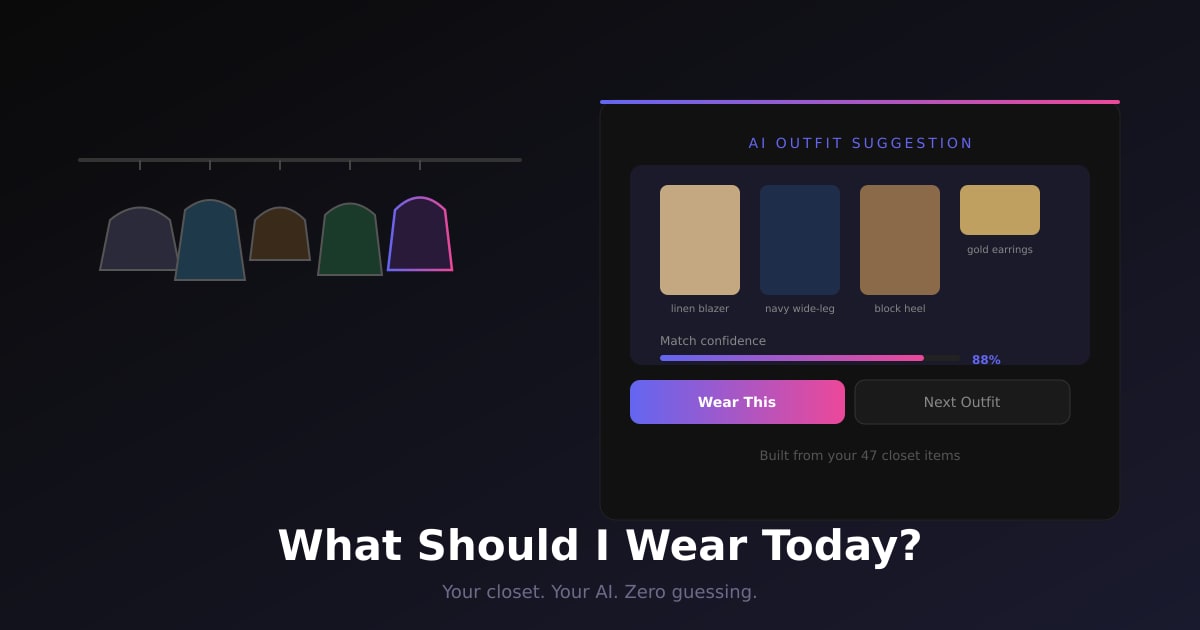
The most stressful part of any dress code isn’t understanding it — it’s standing in front of a full closet and feeling like you have nothing to wear. That gap between “I own clothes” and “I have an outfit” is where most people get stuck.
Dripmatiq closes that gap by building outfits from what you actually own, matched to where you’re actually going. Not a style quiz. Not a shopping list. Just your clothes, styled for your life.
Your closet, decoded.
See what you already own in a whole new way.