Style your closet, your way



· 4 min read
what to wear AI styling outfit planning wardrobe tools outfit confidence
Every morning. The same ceiling. The same question.
“What am I actually going to wear today?”
You have clothes. Lots of them. And somehow the answer is never obvious. You stand there, five minutes ticking by, and eventually grab the same three things you always grab — the ones that require zero thinking.
I used to think this was a personal failing. A creativity problem. Maybe a shopping problem — like if I just bought the right pieces, mornings would be easier.
Spoiler: they didn’t get easier. They got worse.
The Closet Full of Nothing
There’s a name for this feeling in behavioral research: decision fatigue paired with availability bias. Your brain can only hold so many options in working memory at once. In the morning, when your cognitive resources are lowest, the number is even smaller.
So you reach for the familiar. The black jeans. The go-to blazer. The shoes you wear four days a week. Not because they’re the best options — but because they’re the ones your tired brain can surface.
The other stuff might as well not exist.
I had a cream linen blazer I legitimately forgot I owned for six months. Six months. It was right there in my closet the whole time. I “discovered” it again while looking for something else and immediately wore it three times that week.
That’s the problem. Not the clothes. The visibility.
What Changes When AI Can See Your Whole Closet
I downloaded Dripmatiq a few weeks ago expecting to feel the same way I feel about most apps — vaguely hopeful, quickly bored.
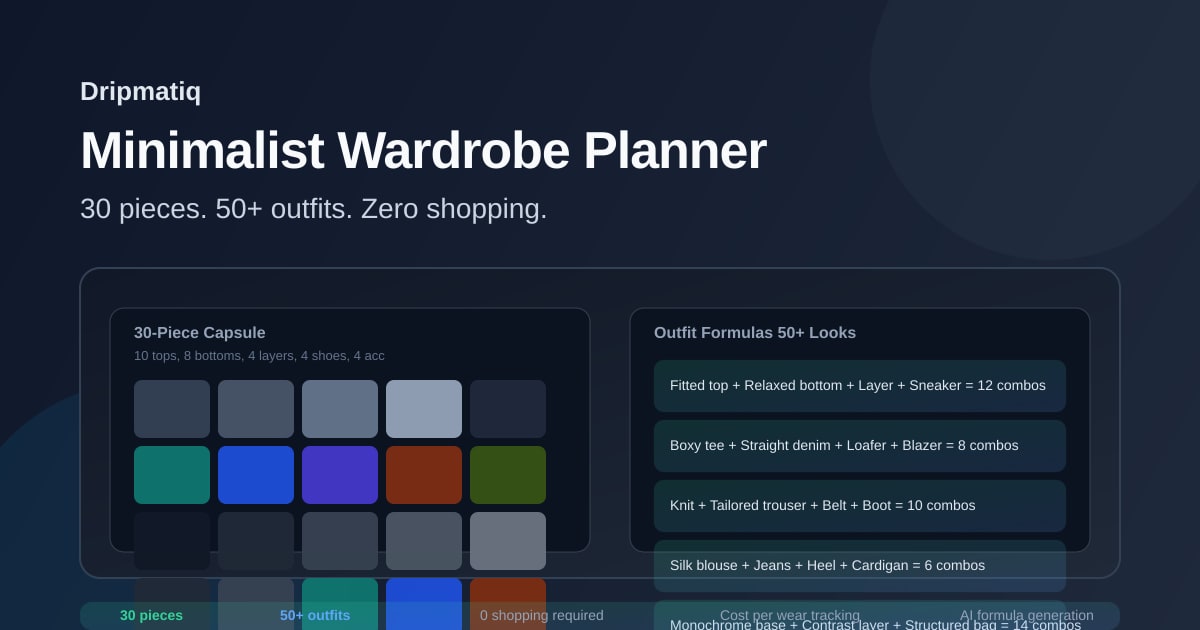
The setup took about twenty minutes. You photograph your actual pieces — your real jeans, your real blazers, your real shoes — and the AI catalogs everything. Then, when you ask what to wear, it builds outfits from your catalog. Not stock photos. Not a stylist’s Pinterest board. Literally the specific items hanging in your specific closet.
The first suggestion it gave me was the cream linen blazer.
Paired with dark navy wide-legs and my block-heel sandals. A combination I would never have thought to try on my own, but when I put it on, it was immediately obvious. Of course that works. Why was I not wearing this?
That’s the thing about AI outfit generation — the wins aren’t magic. They’re just combinations your fatigued brain would never bother to compute at 7 AM.
The Part That Actually Surprised Me
I expected to use it for about a week and move on. That’s my pattern with apps.
What I didn’t expect was the learning loop. Every time you rate or skip a suggestion, the AI gets better at understanding your actual preferences versus your theoretical ones. I thought I was a “neutrals person.” Turns out I wear color all the time — I just don’t buy color intentionally. The AI figured this out before I did.
By week two, the suggestions were different. More confident. Less “here are three random combinations” and more “here’s what you’ll actually reach for.”
And the FitMatic virtual try-on (that’s the Elite tier feature) removed the last friction point for me: the “it looks good in theory but I hate it on” moment. You can see the full look rendered on your actual body before you commit. That alone has saved me probably thirty minutes of putting things on, hating them, and starting over.
The Real Cost of Not Solving This
I did the actual math once. Fifteen extra minutes per morning, five days a week, fifty weeks a year: 62.5 hours. That’s a week and a half of working hours spent on the question of what to wear.
And that’s before the psychological tax. Decision fatigue in the morning genuinely carries into your day. You make worse decisions downstream when you’ve already burned cognitive load on things that shouldn’t require it.
The closet-full-of-nothing feeling also sends most people to the mall. New purchase, temporary relief, same underlying problem six months later with even more clothes you can’t see. I’ve done this cycle so many times.
The answer was never more stuff. It was always visibility.
What Getting Dressed Feels Like Now
Quick. That’s the honest answer. It feels quick.
Some mornings I open the app, approve the first suggestion, and I’m done before my coffee is ready. Other mornings I browse two or three options and pick one. Either way, the decision fatigue is gone.
The cream blazer is one of my most-worn pieces now. It was always there. I just needed something that could see my whole closet at once.
If you’ve ever stood in front of a full closet and felt nothing, the problem is probably not the clothes. It’s the visibility. Dripmatiq is free to try — and the upgrade to Pro is less than a cup of coffee a week.
Your closet is probably already good. You just need an AI that can see all of it.
Your closet, decoded.
See what you already own in a whole new way.