Style your closet, your way



· 6 min read
outfit planning digital-wardrobe AI styling closet organization dripmatiq
Outfit Ideas From My Own Clothes: A Practical AI Workflow That Actually Works
If you keep searching “outfit ideas from my own clothes,” you are not out of style ideas.
You are overloaded.
Most closets are full of good pieces that do not feel visible in the morning. You can picture a few “safe” outfits, maybe one or two elevated looks, then your brain stalls. So you wear the same thing, feel bored, and assume you need to shop.
Usually, you do not.
You need a faster way to see what you already own and combine it on demand.
This guide shows a practical, no-fluff system to generate outfit ideas from your own clothes using a digital closet and simple AI prompts. It is designed for real life: busy mornings, repeat pieces, changing weather, and a budget that does not include random trend hauls.
Why getting dressed feels hard (even with a full closet)
There are three common bottlenecks:
-
Low closet visibility
You physically own options, but mentally access only a small subset. -
No retrieval system
You do not have tags like color, occasion, warmth, or shoe compatibility, so good combinations stay hidden. -
No feedback loop
If you never track what worked, you keep solving the same outfit problem from scratch.
That is why “more clothes” rarely fixes the core issue. Better retrieval does.
The 15-minute setup: from messy closet to usable outfit engine
You do not need to digitize everything today. Start with your core rotation.
Step 1) Log your core 30 pieces
Pull the pieces you wear most often:
- 10 tops
- 8 bottoms
- 4 layers
- 4 shoes
- 4 wildcards (dress, skirt, bag, statement piece)
Take clean photos in natural light. Flat lay or hanger shots both work.
Why 30? It is enough variety to produce meaningful combinations without overwhelming setup.
Step 2) Add high-value tags
For each item, tag:
- Category (tee, button-down, trouser, sneaker)
- Color family (black, cream, olive, denim)
- Warmth (hot weather, mild, cool)
- Dress code (casual, smart casual, work, evening)
- Fit/silhouette (fitted, relaxed, oversized, cropped)
These tags are what make AI suggestions useful. Without tags, suggestions feel random.
Step 3) Build five outfit formulas
Formulas eliminate decision fatigue. Try:
- Fitted top + wide-leg bottom + low-profile sneaker
- Boxy tee + straight denim + loafer + light layer
- Knit top + tailored trouser + belt + minimal jewelry
- Button-down (open) + tank + shorts + sandal
- Monochrome base + contrasting outer layer + structured bag
Formulas are not rigid rules. They are reliable starting points.
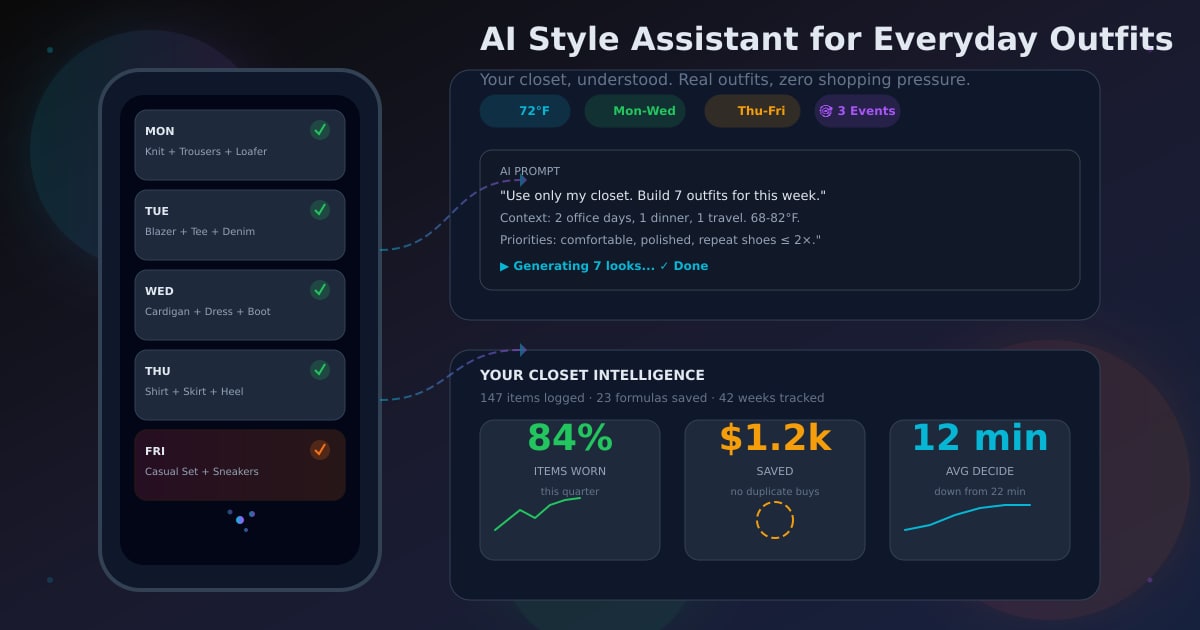
Step 4) Generate seven looks from calendar + weather
Now ask AI for practical outputs, not vague “style inspo.” Use constraints.
Prompt template:
“Use my closet inventory only. Build 7 outfits for this week. Context: two office days, one dinner, one errand day, one travel day. Weather: 68–82°F. Priorities: comfortable, polished, repeat shoes max twice.”
This instantly improves quality because the request is grounded.
Step 5) Save winners and review weekly
At the end of the week, mark:
- Wore and loved
- Wore but adjusted
- Never wore
After 2–3 weeks, patterns appear. You stop guessing and start repeating what actually works for your life.
How AI gives better outfit ideas from your own clothes
AI styling is only as good as the closet data you feed it.
When people say recommendations feel “off,” the usual causes are:
- Missing key items (especially shoes and layers)
- No context (weather, event, comfort needs)
- No outfit history (what they really wear)
When your inventory is complete enough and tagged well, AI can do high-value tasks quickly:
- Surface forgotten combinations
- Balance color and silhouette
- Generate options for a specific event window
- Rework one anchor piece three different ways
- Suggest alternatives when laundry removes your first-choice item
In short: AI is best as a retrieval and planning engine, not a replacement for personal taste.
A weekly outfit planning rhythm you can sustain
People fail outfit planning when it is too complicated. Keep it light.
Sunday (10 minutes): pre-plan
- Check weather
- Check calendar events
- Generate 7 outfit candidates
- Save 3 backups for sudden changes
Weekday morning (2 minutes): choose and go
Pick from pre-built options. Make one small swap if needed.
Friday (5 minutes): review
Tag winners. Note friction points like “shoe uncomfortable after 2 hours” or “needed warmer layer.”
That review data improves future recommendations more than endless scrolling ever will.
What to do if your closet feels boring
Boring usually means under-combined, not under-stocked.
Before buying anything, run this test:
- Pick one ignored piece.
- Force three combinations from current closet.
- Add one variable each time (shoe, layer, accessory).
If you can build three wearable looks from one ignored item, your closet has more range than you thought.
Try these “refresh without buying” moves:
- Swap casual shoe to structured shoe
- Add a single tonal layer
- Tuck/half-tuck to change line
- Add contrast belt or bag
- Flip casual/formal balance (tailored + relaxed)
Small changes create new silhouettes faster than new purchases do.
Common mistakes when using a digital wardrobe app
Mistake 1: Logging only statement pieces
If basics are missing, recommendations fail. Your tees, tanks, plain knitwear, and neutral shoes matter most.
Mistake 2: No dress-code tagging
A black top can be workout, casual, or dinner depending on cut and fabric. Tag context, not just color.
Mistake 3: Ignoring laundry and repeats
Real planning accounts for what is unavailable and how often you repeat shoes or jackets.
Mistake 4: Expecting magic on day one
Your first week is setup. Week two improves. Week three becomes useful and fast.
Outfit idea examples from a 30-piece everyday closet
Here are practical combinations most people can mirror with similar categories:
Work / smart casual
- Ivory knit tee + charcoal trouser + black loafer + thin belt
- Blue button-down + dark straight denim + sleek ankle boot + structured tote
- Ribbed tank + black blazer + cream wide-leg pant + white leather sneaker
Casual day
- Boxy white tee + olive utility pant + gum-sole sneaker + crossbody
- Striped long sleeve + relaxed jeans + ballet flat + cardigan on shoulders
- Cropped sweatshirt + black straight pant + retro sneaker + baseball cap
Dinner / evening casual
- Slip skirt + fitted tee + oversized blazer + low heel sandal
- All-black base (tank + trouser) + silver jewelry + pointed flat
- Dark denim + wrap top + heeled boot + small shoulder bag
Travel / long day out
- Soft knit set + trench + supportive sneaker + roomy tote
- Breathable button-up + drawstring trouser + slide sandal + light scarf
- Stretch tee dress + denim jacket + walking sneaker + belt bag
Notice the pattern: these are not shopping-led. They are combination-led.
How to choose the right app for outfit ideas from your own clothes
When evaluating tools, ask:
- Can I easily log and tag my actual closet?
- Can it suggest outfits using only my own items?
- Can I filter by weather, occasion, and comfort?
- Can I track what I wore and reuse winning looks?
- Does it push shopping, or does it prioritize using what I own?
If an app cannot answer those five well, it will not solve your daily getting-dressed problem.
The bigger win: speed, confidence, and less waste
When you can generate outfit ideas from your own clothes quickly, three things happen:
- You get time back each morning.
- You trust your wardrobe more and second-guess less.
- You buy less impulse clutter because you can see real outfit potential first.
That is the real value of AI styling done right. Not endless inspiration boards. Real outfits, from real clothes, for real days.
Final takeaway
If your goal is better outfits without constant shopping, focus on systems, not trends.
Catalog your core pieces. Tag intelligently. Use constraints. Save what works. Repeat.
You do not need a brand-new wardrobe. You need better access to the one you already built.
And once that system is in place, “What should I wear today?” stops being a daily energy drain.
Want a faster way to put this into practice? Dripmatiq helps you log your real closet, generate outfit ideas from your own clothes, and plan your week without buying more.
Your closet, decoded.
See what you already own in a whole new way.