Style your closet, your way



· 4 min read
aphantasia visual wardrobe outfit planning capsule wardrobe accessibility wardrobe tools
The Outfit You Can’t See
“I can’t picture what an outfit looks like until I’m wearing it.” This confession on r/capsulewardrobe collected 498 upvotes and a 97% approval rate — because it resonated with far more people than expected.
Aphantasia — the inability to form mental images — affects roughly 2-5% of the population. But even people without clinical aphantasia struggle to mentally combine garments. Can you actually see your navy blazer paired with those olive trousers in your mind’s eye? Most people can’t. They just pretend they can.
This isn’t a fashion problem. It’s a cognition problem that fashion has never addressed.
Why Traditional Wardrobe Advice Fails Visual Thinkers
Most capsule wardrobe guidance assumes you can do something impossible: mentally simulate combinations. “Build a colour palette.” “Ensure each piece pairs with at least three others.” “Visualise your ideal outfit and work backward.”
For people with aphantasia or weak mental imagery, this advice is useless. It’s like telling someone who’s colourblind to “just match the tones.” The tool required to follow the instruction doesn’t exist in their brain.
The result? Two common failure modes:
Over-buying. Without mental simulation, you buy duplicates of “safe” items because you can’t picture how anything else would work. Five black tops because you know black works, even if your closet has untapped potential.
Decision paralysis. Every morning becomes a physical try-on session. Pull things out, hold them up, put them back. Repeat until you’re late. The life-stage wardrobe audit helps, but only if you can remember what combinations you’ve already proven work.
What Visual Wardrobe Planning Actually Looks Like
A visual wardrobe planner replaces mental imagery with external imagery. Instead of picturing combinations in your head, you see them on a screen. This sounds obvious — but the implementation matters enormously.
Flat-Lay Photography
The simplest approach: photograph each garment flat against a neutral background. Then arrange combinations digitally. No imagination required — you’re looking at actual images of your actual clothes.
The limitation: flat-lays don’t show drape, proportion, or how fabrics interact on a body. A stiff blazer over a flowing skirt looks different in reality than in a flat-lay grid.
Outfit Logging
Photograph outfits you’ve already worn and loved. Build a lookbook of proven combinations. When you can’t decide what to wear, scroll your own history instead of trying to invent something new.
This is particularly powerful for aphantasia because it replaces imagination with memory — and external memory at that. You don’t need to remember what worked. The photo remembers for you.
Digital Closet Mapping
Upload everything you own. Tag by colour, season, formality, category. Then use combination tools to generate pairings algorithmically. The system does the spatial reasoning your brain won’t.
This approach works especially well with capsule systems because the reduced item count makes comprehensive photography practical. Thirty items photographed and tagged give you hundreds of validated combinations.
The Hidden Accessibility Gap in Fashion
Fashion rarely discusses cognitive accessibility. Physical accessibility — adaptive clothing, seated-friendly designs, sensory-friendly fabrics — has made progress. But the assumption that everyone can think about clothes the same way remains unchallenged.
Consider:
- ADHD and working memory. Holding multiple garment images in mind while evaluating combinations requires working memory that ADHD brains often can’t spare in the morning rush.
- Autism and decision matrices. Many autistic people prefer systematic approaches to clothing. “Does this match?” is an ambiguous question. “These items score 8/10 on colour harmony” is concrete and useful.
- Executive function challenges. Anyone dealing with depression, fatigue, or cognitive fog benefits from decisions made in advance and stored externally.
Visual wardrobe tools aren’t a luxury. For millions of people, they’re the difference between getting dressed with confidence and getting dressed with dread.
How to Build Your External Outfit Memory
You don’t need an app to start. Here’s a manual system that works:
Step 1: Photograph your top 20 pieces. Not everything — just the items you reach for most. Flat against a white wall or bedsheet. Natural light. Takes about 30 minutes.
Step 2: Combine and photograph. Spend one weekend assembling outfits from those 20 pieces. Lay out full looks — top, bottom, layer, shoes. Photograph each one. You’ll likely get 15-25 distinct outfits.
Step 3: Create a “morning folder.” Save outfit photos in a phone folder called “Outfits.” Tomorrow morning, instead of staring into your closet, scroll the folder. Pick one. Done.
Step 4: Add new combinations as you discover them. Wearing something new that works? Photograph it before you leave the house. Your lookbook grows organically.
The third-piece styling rule becomes dramatically easier when you can see examples rather than imagine them. Add a scarf, a jacket, a hat — and photograph the difference.
When Technology Meets Cognitive Needs
Manual systems work but have friction. You have to remember to photograph. You have to maintain the folder. You have to scroll through dozens of images to find the right one for today’s weather and context.
This is where intelligent wardrobe tools earn their value — not as a novelty, but as a genuine accessibility aid. Auto-categorisation, weather-aware suggestions, occasion filtering, and combination scoring all reduce the cognitive load that makes getting dressed hard for visual thinkers.
The 498-upvote Reddit thread proved the need exists. The question is whether fashion technology will meet it — or keep building features that assume everyone can picture outfits in their head.
Your Closet Doesn’t Require Imagination
The best wardrobe system for you is the one that doesn’t rely on your weakest cognitive skill. If you can’t picture outfits mentally, stop trying. Build an external visual system instead.
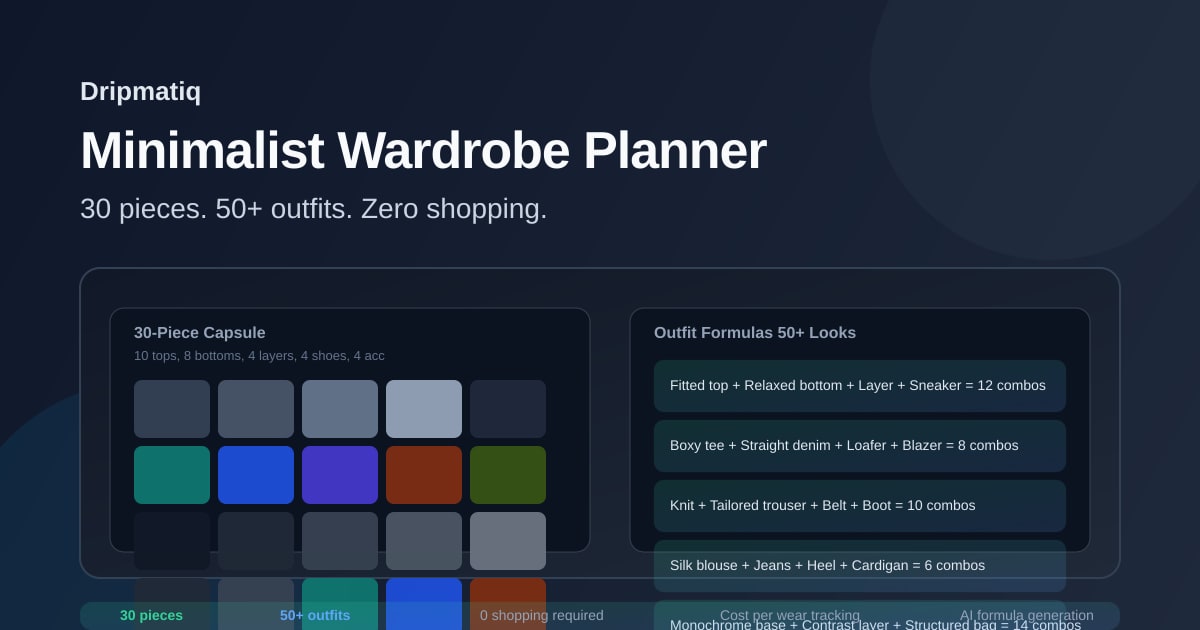
Dripmatiq was designed with this exact insight — your closet photographed, your combinations surfaced algorithmically, your proven outfits saved as a scrollable lookbook. No imagination required. Just evidence of what already works.
Your closet, decoded.
See what you already own in a whole new way.